Last night we had a great turn out for our Agvocating event on campus. We all walked away with a lot of new information on how we can be better advocates to our industry. Students, faculty, community members, Farm and Dairy, Ohio Country Journal/Ohio Ag Net, and Certified Angus Beef were in attendance. I would like to start out with a big thank you to all who cam out!
The evening started out with our Keynote Speaker, Dr. Bobby Moser, dean of The Ohio State University College of Food, Agriculture, and Environmental Sciences. Dr. Moser talked to us about The Ohio Livestock Care Standards Board. This board was put together to help put in place regulations on better care practices for livestock in the great state of Ohio. Seeing that activist groups such as HSUS and PETA were starting to place ballot issues in other states in our country, Ohio decided to get ahead of the game and form these standards. We learned last night that in mid-July the board hopes to have the regulations finalized and in place. Dr. Moser also had a rough draft copy with him in case anyone wanted to look over the new regulations. He talked about the history of the board how it came about, as well as why we need this board.
Next to speak was Dr. Leah Dorman D.V.M. from The Ohio Farm Bureau Dr. Dorman put a large emphasis on the fact that we need to know and understand what activist groups are doing, and that we need to follow them even though it might seem unnatural. Leah entertained the crowd with great pictures and getting everyone in the room involved. She also talked to us about how we can get involved in the board through sub committees and different commodity groups.
The last to present last night was Dan Toland from The Ohio Farm Bureau. Dan being a technology guru, talked to us about how we as young producers can get involved in social media, so we can get our story out there before someone else does. There was a twitter hash tag set up for the night, and he had all the tweets running throughout his presentation as they were uploaded throughout the event that night. In the 3 hours spent during the presentations there was a total of 50 tweets sent from the room, and viewed by over 20,500 people during the event. That's crazy in my opinion and that's real time, that was the point he was trying to get across. He also explained how many people use social media and that they are our number one target.
Again, I would like to thank all who attended and Farm and Dairy and Ohio Country Journal/Ohio Ag Net for being present as media coverage. The support is appreciated. To find out more information follow Farm and Dairy and Ohio Country Journal/Ohio Ag Net on Facebook and upcoming issues for complete coverage on what happened last night.
Everybody loves corn
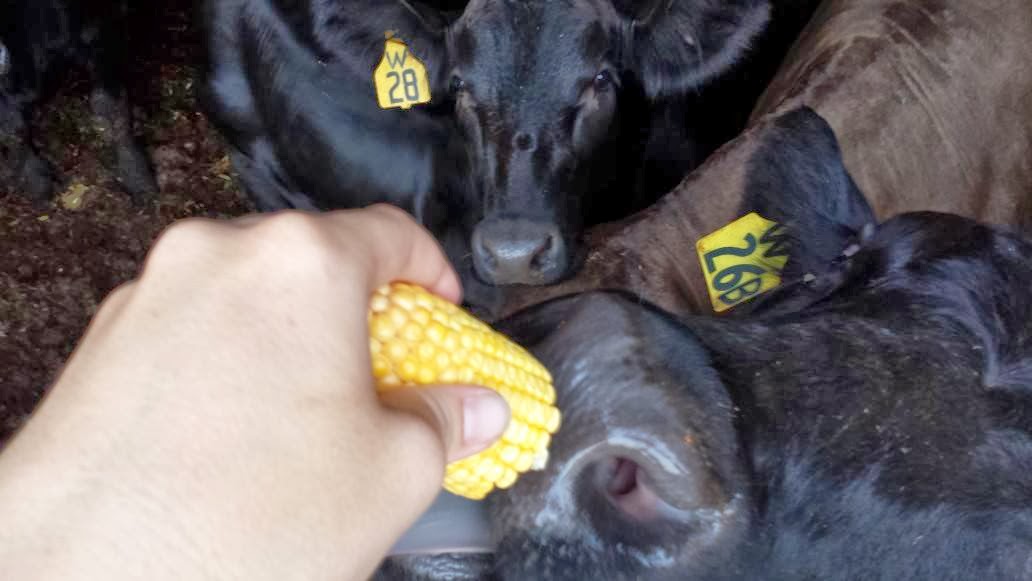
After I walked the corn field next to the barn, I thought it was fitting to give the steers a little snack.
Wednesday, May 18, 2011

Monday, May 16, 2011
How Can You Tell Your Story
As part of our project on Agvocating, Sam and I are hosting an event on the ATI campus. We are having 3 guest speakers coming and talking about how we can use social media and to educate us about the Ohio Livestock Care Standards Board.
Dan Toland a communications specialist with The Ohio Farm Bureau, is going to be talking about how we as producers can use social media sites such as Facebook, Twitter, and different blogging sites to tell our story and let our voices be heard.
Leah Dorman D.V.M. from the Ohio Farm Bureau is well versed with issues dealing with The Ohio Livestock Care Standards Board and is going to be talking about how important it is, and what we as young producers need to learn from it.
Finally Dr. Bobby Moser Dean of the College of Food Agriculture and Environmental Sciences at The Ohio State University will be talking about what the Livestock Care Board is, how it came to be, and why it is so important that we have the Livestock Care Board.
The event is Tuesday May, 17th at The Ohio State University Agricultural Technical Institute in Skou Hall room 100, with refreshments starting at 6:30pm and the presentations for the night starting at 7pm. Everyone that is willing to learn about the Livestock Care Standards Board and wanting to learn how to positively use social media to promote agriculture is welcome to come.
Dan Toland a communications specialist with The Ohio Farm Bureau, is going to be talking about how we as producers can use social media sites such as Facebook, Twitter, and different blogging sites to tell our story and let our voices be heard.
Leah Dorman D.V.M. from the Ohio Farm Bureau is well versed with issues dealing with The Ohio Livestock Care Standards Board and is going to be talking about how important it is, and what we as young producers need to learn from it.
Finally Dr. Bobby Moser Dean of the College of Food Agriculture and Environmental Sciences at The Ohio State University will be talking about what the Livestock Care Board is, how it came to be, and why it is so important that we have the Livestock Care Board.
The event is Tuesday May, 17th at The Ohio State University Agricultural Technical Institute in Skou Hall room 100, with refreshments starting at 6:30pm and the presentations for the night starting at 7pm. Everyone that is willing to learn about the Livestock Care Standards Board and wanting to learn how to positively use social media to promote agriculture is welcome to come.
Monday, May 2, 2011
Some Food For Thought
In the age of being able to record video at the drop of a hat, more and more videos of animal abuse keep popping up. The question then comes up about privacy. In my opinion it is an invasion of privacy, it's not that I'm ashamed of what I do on the farm with my cattle, it's that to be able to get things done with an animal thats 10 times my size, yes some of our actions may not be appealing.
I found a short little blurb on a blog that really highlights this thought as well as some others, about why animal agriculture really isn't all green grass, and happy cows basking in the sun.
 Does this mean I think all farms and ranches should install cameras, upload their footage to YouTube, then tweet it and cross-populate to Facebook? Absolutely not. I’m not a fan of putting video cameras in barns because animal agriculture isn’t pretty. And until the public is more familiar with this reality, I’m not sure they’re ready to see the scenario that I describe above – which was not on a “factory farm.” I also believe it should be a farmer’s choice on his/her own property.
I found a short little blurb on a blog that really highlights this thought as well as some others, about why animal agriculture really isn't all green grass, and happy cows basking in the sun.
Candid Cameras on Factory Farms
Many businesses with intellectual property don’t allow cameras; think John Deere, Ford, Google. Homes are protected from such invasions on privacy; imagine how you’d feel to discover a hidden camera in your bedroom. But what about farms? If you’re a part of animal agriculture, you need to consider how you’d look on candid camera. Ongoing videos from animal rights activists and legislation proposed to make such such actions illegal in Iowa, Minnesota and Florida have brought the issue to the forefront. On the opposite end of the spectrum are those who believe every operation should install cameras.
The nasty videos aren’t going to stop. There are bad apples who don’t deserve to be called farmers. There are also terrible humans, who have gone through rigorous screening by a farm and signed paperwork against abuse, but still end up in the barns doing terrible things to animals. And, yes, there are groups who stage such abuse to further their cause. We have to accept that these videos will keep coming. The question is what we do to protect both the families and animals involved.
Do farms have something to hide? The proposed legislation is certainly being viewed that way. I struggle with this; it should be as wrong for trespassers to be video taping on a farm as it is for someone to walk in a school and film children. Both should require permission – and have legal ramifications if none is given. Likewise, any abuse that’s filmed should be turned over to the authorities – immediately. Not waiting 3 days or 3 weeks to execute a strategic campaign to raise funds or publicity for your organization – but immediately.
Farmers aren’t hiding animal abuse, but animal agriculture isn’t pretty. As I write this, we’ve had record-high rainfalls in the central Midwest – which means cattle are standing knee deep in mud in some locations. These same cattle graze in lush green pastures and lounge in the sunshine in summer (to the envy of this human). But it’s simply not pretty right now – no matter how much cleaning and care is given – or if it’s a “factory farm” or small operation.
Another not so pretty reality; animal agriculture practices can look terrible, even when done in the best interest of the animal. We had a cow go down on pasture last summer on a 90 degree day. Keeping this animal alive required me smacking her across the face and kneeing her chest as hard as my human weight could muster. Before you judge me; consider the shock it takes to keep a human heart going – and then multiply that by 10. Once we had the heavy equipment ready (a necessity with downed animals) we got her off the ground by putting a metal device around her hip bones and then raised the hip lifts with a tractor so she could stand. When she was steady enough to walk, we helped her back to the barn, with urine pouring out of her and manure all over (cows don’t use bed pans).
Is this an image we want on camera? I think not. It would have looked terrible on CNN and would been incorrectly labeled as animal abuse. Yet, the cow lived and did not suffer needlessly – because two women cared enough to do some “ugly” things in the interest of animal husbandry. The same scenario is played out a hundred different ways on farms (large and small) across the country every day. Animals get hurt, need to be euthanized and do stupid things like getting their heads jammed into places they don’t belong. If you work with animals, you know this. But I’d wager 99% of the population does not know these things about farm animals firsthand. And more to the point, they won’t have any knowledge unless you help them.
 Does this mean I think all farms and ranches should install cameras, upload their footage to YouTube, then tweet it and cross-populate to Facebook? Absolutely not. I’m not a fan of putting video cameras in barns because animal agriculture isn’t pretty. And until the public is more familiar with this reality, I’m not sure they’re ready to see the scenario that I describe above – which was not on a “factory farm.” I also believe it should be a farmer’s choice on his/her own property.
I applaud those that have installed cameras, including J.S. West with chickens and Belstra with pigs – and know many more are considering it. What is recorded should remain as a farm’s choice. But the lack of desire to have “candid cameras” on farms doesn’t mean that farmers and ranchers aren’t being transparent. It simply means that farms are a place of a business, a family’s livelihood and yes – a place of privacy.
The opinion that this person expresses is right in line with how I feel. Until the public understand why we do what we do, and the reasoning behind it we can not have cameras on farms.
This blog post was pulled from http://www.causematters.com/ There are a lot of real good posts on this site and I suggest spending sometime reading through some of the posts.
Wednesday, April 20, 2011
This is NOT Agriculture!
Every social media site today has been buzzing with the most recent video posted by the Animal Rights Activists Group, Mercy for Animals. So I have finally had the time to sit down and watch the video. I am literally sick to my stomach. The abuse that happens to the calves in this video is outrageous. I have no words.
The only words that I do have to offer are, THIS IS NOT AGRICULTURE! The people that were being filmed in this video have no right to be involved in agriculture at all. On our farm and 99% of the farms around the country, our animals are treated with respect and dignity. We have a small cow calf operation, which is different setup and concepts from the farm in the video, but, our calves are born and then they are separated out of the main herd with their mothers for a week so we can watch the calves and make sure they are healthy.
I have worked on a couple dairy farms in my time. As soon as a calf hits the ground we take care of that animal. Most dairy's have no use for bull calves, they are feed on the farm for about a week and then sold to farms that can raise them out, the people that buy those bull calves raise them to steers and sell them at market or they go to their personal freezer.
All the animals in the video that I could tell were bull calves or very sick heifers, there are other more humane, more professional ways to take care of our animals. I don't know the whole story or all the details but please just please understand that this case of abuse is not how we do things. Like I said, I can't find the right combination of words to explain how I feel, but please don't look down on me as a producer because of one bad apple, farming is my lifestyle and I wouldn't have it any other way.
I am not posting a link to this video, because this video is not for the weak at heart at all. If you are interested in looking it up, on Youtube type Mercy for Animals Calves into the search, it is a video that is a new cast. This is the much more condensed easier to watch video, but the video is still very hard to watch. If you have any questions about animal agriculture and the way we do things, please feel free to comment and I will answer them.
Sunday, April 17, 2011
Everyone Needs to Do Some Research
I absolutely love YouTube. Its a great place where you get to share your personal opinions through video...or just post something funny that's gonna give people a good laugh.
I honestly really like watching videos that throw a negative image on Agriculture. That may seem weird to some, but we need to listen to what other people think and try to educate ourselves on their opinions so that we can have a civil conversations with them.
One of my favorite videos that sparks a lot of controversy is a video entitled Genetic Engineering: The Worlds Greatest Scam. http://www.youtube.com/watch?v=1H9WZGKQeYg&feature=related Take a second and watch it...
The first thing that hits me in this video is how these "horrible" crops are produced outdoors, I just think it's funny, where else an I going to grow it right?? Anyway, I can see the point that they are trying to make, when we grow these GMO(Genetically Modified Organisms) or "traited" (the term widely used in the industry) plants next to a field that has no traits in the seed, they will cross, and that seed is then modified as well, that's basic pollination principals. Those plants that are not traited or conventional (term used in the industry) will suffer, because my plant that is glyphosate tolerant, (glyphostate is a herbicide) it is not going to be hurt my corn when I spray for weeds, but herbicide drift will effect my neighbors corn that is conventional, that's a situation where the producers need to work together and talk about what they have in the field.
The next point that GreenPeace hits on is how these traited products are patented and that there is then a dependence on those big companies. The reason that we have to keep records is because of the United States Department of Agriculture not the company its self. Another reason we do this is because of basic patenting laws, someone invents something, they throw a patent on it, so that they can make the money for the hard work they put into it.
Something that stands out to me in the next piece is when they are talking about the pesticides. Yes those companies have the products for a person to use with their seed, making it easier for the farmer to buy products, and know that they are mixing the right things together, again just like Tostitos Chips, they have their own salsa and cheese dip too...Are you seeing how easy it is to put all these things into real life situations??
Pesticide resistance is a big issue that we are starting to face, but, that can be easily fixed by being a better steward to our environment, and as simple as reading the label on the jug. Some people are careless and do not follow the rules on the jug, and use only those products, it is better to switch out those products and use other ones, then resistance is not going to be an issue.
Does anyone else think the little clip with the animals on the conveyor belt or the "Meat Machine" is funny?? I find it a little amusing. I may be cold and heartless to some, but that's not how meat production works at all, I'm just going to save that conversation for another time.
Finally to wrap up my little synopsis of this video, yes I agree we really don't know what is going to happen to us if we eat these products, I personally haven't grown a third arm yet, but in time we will find out, just like we now know the effects of smoking, lead based products, and the use of seat belts.
So next time that you hear anything negative about anything. Remember this article and think, we really do need to become educated from all angles so that you can then form a formal and educated opinion on why you believe what you believe.
I honestly really like watching videos that throw a negative image on Agriculture. That may seem weird to some, but we need to listen to what other people think and try to educate ourselves on their opinions so that we can have a civil conversations with them.
One of my favorite videos that sparks a lot of controversy is a video entitled Genetic Engineering: The Worlds Greatest Scam. http://www.youtube.com/watch?v=1H9WZGKQeYg&feature=related Take a second and watch it...
The first thing that hits me in this video is how these "horrible" crops are produced outdoors, I just think it's funny, where else an I going to grow it right?? Anyway, I can see the point that they are trying to make, when we grow these GMO(Genetically Modified Organisms) or "traited" (the term widely used in the industry) plants next to a field that has no traits in the seed, they will cross, and that seed is then modified as well, that's basic pollination principals. Those plants that are not traited or conventional (term used in the industry) will suffer, because my plant that is glyphosate tolerant, (glyphostate is a herbicide) it is not going to be hurt my corn when I spray for weeds, but herbicide drift will effect my neighbors corn that is conventional, that's a situation where the producers need to work together and talk about what they have in the field.
The next point that GreenPeace hits on is how these traited products are patented and that there is then a dependence on those big companies. The reason that we have to keep records is because of the United States Department of Agriculture not the company its self. Another reason we do this is because of basic patenting laws, someone invents something, they throw a patent on it, so that they can make the money for the hard work they put into it.
Something that stands out to me in the next piece is when they are talking about the pesticides. Yes those companies have the products for a person to use with their seed, making it easier for the farmer to buy products, and know that they are mixing the right things together, again just like Tostitos Chips, they have their own salsa and cheese dip too...Are you seeing how easy it is to put all these things into real life situations??
Pesticide resistance is a big issue that we are starting to face, but, that can be easily fixed by being a better steward to our environment, and as simple as reading the label on the jug. Some people are careless and do not follow the rules on the jug, and use only those products, it is better to switch out those products and use other ones, then resistance is not going to be an issue.
Does anyone else think the little clip with the animals on the conveyor belt or the "Meat Machine" is funny?? I find it a little amusing. I may be cold and heartless to some, but that's not how meat production works at all, I'm just going to save that conversation for another time.
Finally to wrap up my little synopsis of this video, yes I agree we really don't know what is going to happen to us if we eat these products, I personally haven't grown a third arm yet, but in time we will find out, just like we now know the effects of smoking, lead based products, and the use of seat belts.
So next time that you hear anything negative about anything. Remember this article and think, we really do need to become educated from all angles so that you can then form a formal and educated opinion on why you believe what you believe.
Tuesday, April 12, 2011
Spring I On It's Way
Springtime might finally be here in North Central Ohio. The weather on Sunday was something we all needed to remind us that it isn't going to be winter forever. With spring in the air, comes all the hustle and bustle of the spring planting season.
To each of us agriculturalists we view spring just a little different. To me, that means getting the tractors hooked to tillage equipment and start turning dirt. Now you can't tell me that, that isn't the best smell in the world, fresh turned dirt! We work the ground on our farm as not only a way to prepare the seed bed, cause we all know seed to soil contact is a must, but as a way to kill those winter perennial weeds that seem to grow during the colder months. This also allows us to use less herbicides, which in turn is much better for our environment.
Some might not like the way we do things in a commercial operation, but that's the way we do things. To each their own and whatever works for you might not work for the next guy. I say this because I sat down at a very informal meeting with a couple people that are organic producers. To me quizzing each other back and forth was great. Explaining why I do this, and why that won't work for me, also learning to hold my tongue and letting others speak was very important.
For me to do what I want to do as an Agvocate, I need to be able to listen to others and hear their opinions without getting defensive or even bashing the other guy. Because the way I see it, we as agriculturalists need to band together no matter what sector of agriculture, or what type of operation we have. If we don't band together and learn to speak for each other, in the long run, someone is going to be doing the speaking for ALL of us, and we won't be able to do things the way that they need to be done.
Back to where I was with the tillage...Tillage is a great tool to use to cut down on weed population, but here lately the use of tillage has taken a step back, this is because no-till systems are now in place. We run both till and no-till on our farm. Here is just a quick link to follow that explains a no-till cropping system vs. the conventional cropping system that you might be familiar with...
http://extension.missouri.edu/publications/DisplayPub.aspx?P=G4080
To each of us agriculturalists we view spring just a little different. To me, that means getting the tractors hooked to tillage equipment and start turning dirt. Now you can't tell me that, that isn't the best smell in the world, fresh turned dirt! We work the ground on our farm as not only a way to prepare the seed bed, cause we all know seed to soil contact is a must, but as a way to kill those winter perennial weeds that seem to grow during the colder months. This also allows us to use less herbicides, which in turn is much better for our environment.
Some might not like the way we do things in a commercial operation, but that's the way we do things. To each their own and whatever works for you might not work for the next guy. I say this because I sat down at a very informal meeting with a couple people that are organic producers. To me quizzing each other back and forth was great. Explaining why I do this, and why that won't work for me, also learning to hold my tongue and letting others speak was very important.
For me to do what I want to do as an Agvocate, I need to be able to listen to others and hear their opinions without getting defensive or even bashing the other guy. Because the way I see it, we as agriculturalists need to band together no matter what sector of agriculture, or what type of operation we have. If we don't band together and learn to speak for each other, in the long run, someone is going to be doing the speaking for ALL of us, and we won't be able to do things the way that they need to be done.
Back to where I was with the tillage...Tillage is a great tool to use to cut down on weed population, but here lately the use of tillage has taken a step back, this is because no-till systems are now in place. We run both till and no-till on our farm. Here is just a quick link to follow that explains a no-till cropping system vs. the conventional cropping system that you might be familiar with...
http://extension.missouri.edu/publications/DisplayPub.aspx?P=G4080
Sunday, April 3, 2011
Starting That Final Quarter
Here we are, almost ready to start week two of Spring Quarter here at ATI. I cannot believe that on June 11, 2011 I will officially be done with school. But there are a couple things standing in my way, classes and homework. One of those classes is an Independent Study in Agvocacy. I personally am going to do a collection of both animal and row crop agvocacy. Being a livestock producer and a row crop farmer there are a lot of issues that I can face on a daily basis.
The first thing that I think I need to bring attention to is a post I saw on my Facebook wall. I have a friend that I met at The New Century Farmer Conference that is eating a steak tonight because he has decided to go vegan for a week, he really isn't 100% sure why he is doing it, but to better understand something, might as well try it, right?
This brings to me to my next point; is there really something as being "completely vegan". I found an interesting picture online about veganism. It's a picture of a steer showing what all parts of the steer go into different everyday items. Did you know that products such as chewing gum, crayons, paint, rubber, and fireworks are made of animal fat?? That your favorite anti-aging cream has by-products from the cows brain? Also that our everyday medicines have by-products from multiple parts of the steer. There are so many more that I haven't listed, and that aren't listed on the picture, leaves me with a thought for you...
Think about what people are telling you, and do some research for yourself, whether you are for or against animal agriculture, because we all need to understand one another's opinions to be able to respect what we all do.
Here is a copy of the link to go check out the picture for yourself! http://fitperez.com/2010-10-26-interesting-picture
The first thing that I think I need to bring attention to is a post I saw on my Facebook wall. I have a friend that I met at The New Century Farmer Conference that is eating a steak tonight because he has decided to go vegan for a week, he really isn't 100% sure why he is doing it, but to better understand something, might as well try it, right?
This brings to me to my next point; is there really something as being "completely vegan". I found an interesting picture online about veganism. It's a picture of a steer showing what all parts of the steer go into different everyday items. Did you know that products such as chewing gum, crayons, paint, rubber, and fireworks are made of animal fat?? That your favorite anti-aging cream has by-products from the cows brain? Also that our everyday medicines have by-products from multiple parts of the steer. There are so many more that I haven't listed, and that aren't listed on the picture, leaves me with a thought for you...
Think about what people are telling you, and do some research for yourself, whether you are for or against animal agriculture, because we all need to understand one another's opinions to be able to respect what we all do.
Here is a copy of the link to go check out the picture for yourself! http://fitperez.com/2010-10-26-interesting-picture
Subscribe to:
Posts (Atom)